
|
 |
Home |  |
|
About BFIS | |
|
Species List | |
|
Risk Analysis | |
|
Harmonia⁺ | |
|
Resources | |
|
Outputs | |
|
Mailing List | |
|
Registry | |
|
|
|
 |
Contact us | Login | |  |
|
|
|
|
|
|
|
|
|

|
|
©
Sonia Vanderhoeven, FUSAGx
©
Etienne Branquart, Belgian Biodiversity Platform
©
Etienne Branquart, Belgian Biodiversity Platform
©
Etienne Branquart, Belgian Biodiversity Platform
 Naturalization in Belgium Naturalization in Belgium
Invasiveness
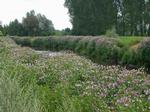
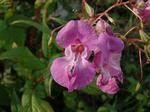
More on invasiveness: I. glandulifera occurs in many different habitats, but it thrives best on moist and nutrient rich alluvial soils. It has a high tolerance to heavily compacted soils. It occurs on meadows, along rivers and brooks, and in floodplain forests, especially in areas disturbed by man. Long-distance dispersal of seeds is aided by flowing water, with fresh seeds transported in sediment on the beds of rivers, and dry seeds being buoyant can float over large distances.
Distribution in Belgium
Established populations

Endangered areas
Impacts on Species
Impacts on Ecosystems
More on impacts: I. glandulifera may form dense stands that cover the soil, shade out and replace native annual and even perennial plant species because of early germination and rapid growth. In some conditions, it can strongly reduce local species richness but this reduction is often temporary and concerns mostly widespread weed and even other non–native species in function of ground-water table and flooding conditions. It may also displace native species through competition for pollinators, e.g. Stachys palustris. Its development can facilitate river bank erosion.
References:
AEF (2006)
Cartes provisoires de la distribution de néophytes en Wallonie.
Unpublished document.
Chittka L. & Schurkens S. (2001)
Successful invasion of a floral market.
Nature 411: 653-655.
Essl, F. & Rabitsch, W. (2003)
Neobiota in Osterreich.
Umweltbundesamt, 432 pp.
Godefroid, S. & Koedam, N. (2004)
Interspecific variation in soil compaction sensitivity among forest floor species.
 Biological Conservation 119: 207-217.
Hejda M. & Pysek P. (2006)
What is the impact of Impatiens glandulifera on species diversity of invaded riparian vegetation?
Biological Conservation 132: 143-152.
Hejda, M., Pysek, P. & Jarosik, V. (2009)
Impact of invasive plants on the species richness,
diversity and composition of invaded communities.
Journal of Ecology 97: 393–403.
Helmisaari, H. (2006)
Invasive alien species fact sheet Impatiens glandulifera
From online database of the North European and Baltic network on invasive alien species (NOBANIS).
Hulme P.E. & Bremner E.T. (2006)
Assessing the impact of Impatiens glandulifera on riparian habitats: partitioning diversity components following species removal.
Journal of Applied Ecology 43: 43-50.
Kasperek, G. (2004)
Fluctuations in numbers of neophytes, especially
Impatiens glandulifera , in permanent plots in a west German floodplain during 13 years.
In: Kühn, I.& Klotz, S. (Eds.), Biological Invasions: Challenges for Science. NEOBIOTA 3: 27-37.
Lambinon, J., Delvosalle, L. & Duvigneaud, J. (2004)
Nouvelle fore de la Belgique, du Grand-Duché de Luxembourg, du Nord de la France et des régions voisines.
Editions du Patrimoine du Jardin botanique national de Belgique, Meise.
Muller, S. (2004)
Plantes invasives en France : état des connaissances et propositions d'actions.
Publication scientifique du Museum d'Histoire naturelle, Patrimoines naturels n°62.
Perrins J., Fitter A. & Williamson M. (1983)
Population biology and rates of invasion of three introduced Impatiens species in the British Isles.
Journal of Biogeography 20: 33–44.
Toussaint, B. & Bedouet, F. (2005)
Les espèces végétales invasives des milieux aquatiques et humides du bassin Artois-Picardie.
Agence de l'Eau Artois-Picardie, 38 pp.
Van Landuyt, W., Hoste, I., Vanhecke, L., Van den Bremt, P. Vercruysse, W. & De Beer, D. (2006)
Atlas van de Flora van Vlaanderen en het Brussels gewest.
Nationale Plantentuin en het Instituut voor Natuur- en Bosonderzoek i.s.m. Flo.Wer vzw.
Verloove, F. (2006)
Catalogue of the Neophytes in Belgium (1800-2005).
 Scripta Botanica Belgica 39, 89 pp.
Wadsworth R.A., Collingham Y.C., Willis S.G., Huntley B. & Hulme P.E. (2000)
Simulating the spread and management of alien riparian weeds: are they out of control?
Journal of Applied Ecology 37: 28-38.
Walker, N.F., Hulme, P.E. & Hoelzel, A.R. (2009)
Population genetics of an invasive riparian species, Impatiens glandulifera.
Plant Ecology 203:243–252.
Willis S.G. & Hulme P.E. (2002)
Does temperature limit the invasion of Impatiens glandulifera and Heracleum mantegazzianum in the UK?
Functional Ecology 16: 530-539.
|
 |





|
 |